
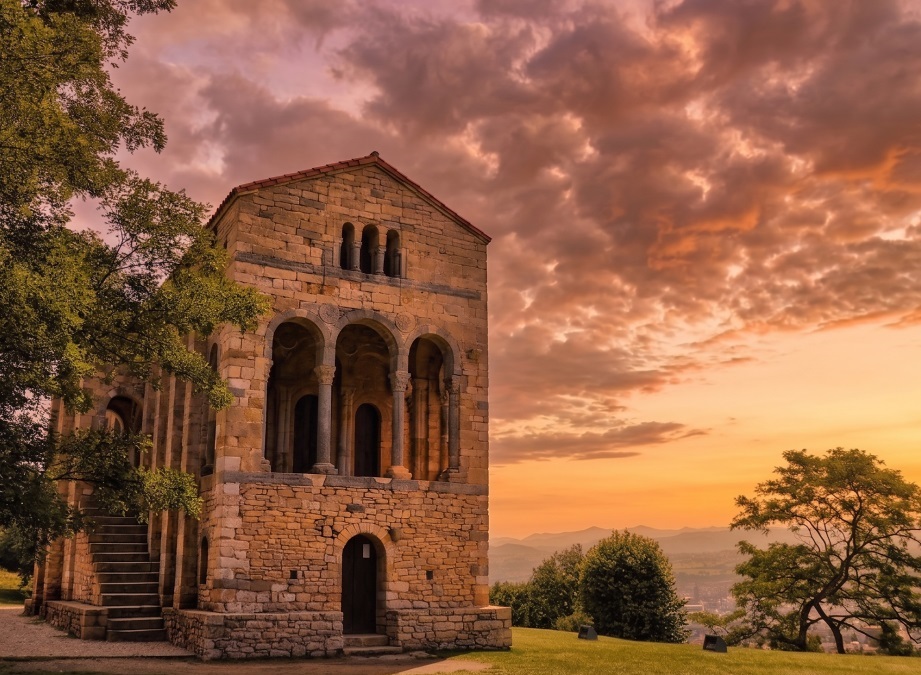
Santa Maria del Naranco and San Miguel de Lillo: Pre-Romanesque Temples on Mount Naranco
Asturias boasts the best-preserved complex of early Medieval architecture in all of Western Europe. The two crowning jewels of this heritage—the churches of Santa María del Naranco and San Miguel de Lillo—are perched on the slopes of Mount Naranco, just four kilometers from the center of Oviedo.
Santa María del Naranco
Built as far back as 842 AD, Santa María was originally designed as a multi-purpose religious and public building. It likely served as a royal pavilion for rest and hunting, as well as a site for the tomb of King Ramiro I—a fact confirmed by archaeological excavations. The Chronicle of Albelda (Rotense) states that the king “built many buildings of stone and marble, without beams, with vaulted work.”
Regardless of its primary purpose, this two-story rectangular building with its complex barrel vaults and ribbed arches was an architectural breakthrough. This design allowed for stone construction in an era where wood was previously the only option for such spans.
The triple arches of the upper level have become an iconic symbol in Asturian tourism. Also noteworthy are the 32 medallions distributed throughout the building. While similar in size and shape, they feature diverse decorative patterns and figures, including animals, birds, bunches of grapes, and mythical characters.
San Miguel de Lillo
Located just 100 meters further up the slope stands San Miguel de Lillo, erected in 848 AD as a royal chapel dedicated to the Archangel Michael—the king’s protector in spiritual battles.
The building features an exceptionally rich program of carved decoration. Much like Santa María del Naranco, most of these carvings are integrated into the structural elements, proving that San Miguel was also built according to a meticulously pre-defined plan.
The Famous Entrance Jambs
The church’s greatest treasure is the carved jambs of the main entrance. They are decorated with three figurative scenes repeated on each side. The jambs are divided into three panels framed by a rope-like profile, containing various ornamental motifs.
Stone Openwork Screens (Celosías)
A distinct feature of San Miguel is its windows, all decorated with intricate openwork screens carved directly into stone (celosías). The craftsmanship is masterful: the lower sections feature semi-circular arches on columns and capitals, while the upper sections are adorned with rosettes or additional arches ending in a semi-circular crown.
UNESCO Recognition
Both monuments were inscribed on the UNESCO World Heritage List in 1985. They are recognized as unique examples of the culture of the Kingdom of Asturias, having exerted a colossal influence on all subsequent European architecture.
Practical Information: Planning Your Visit
How to Get There
- Bus: Line A2 takes you from central Oviedo to the monuments; Line A1 takes you back to the city.
- On Foot: About 4 km uphill from the city center. The path is very scenic, so allow extra time for the walk.
- By Car: You can park briefly on the roadside nearby or drive slightly further to the bus stop for a full parking area.
Price and Opening Hours (2026)
- Tickets: A combined ticket for both sites costs €5. You can purchase it at the ticket office near Santa María del Naranco.
- Guided Tours: Access is only available via a guided group tour (up to 25 people). The duration is approximately 40 minutes.
- Free Entry: Monday mornings (self-guided tour, no guide).
- Operating Hours:
- Summer (April 1 – Sept 30): Tue–Sat 9:30–13:00 & 15:30–19:00. Sun & Mon 9:30–13:00.
- Winter (Oct 1 – March 31): Tue–Sat 10:00–14:30. Sun 10:00–12:30.
Travel Tips
- Interpretive Center: Before heading to the churches, stop by the Pre-Romanesque Asturian Art Interpretation Center at the foot of the mountain. It provides essential context regarding the history and symbolism of the buildings.
- The Summit: Hike further up to the Statue of Christ (Sagrado Corazón) at the peak. The panoramic view of Oviedo and the Picos de Europa mountain range is worth the effort.
- San Julián de los Prados: If you enjoy this style, visit the church of San Julián de los Prados within the city—it is even older and larger in scale.